Introduction
Every time a basketball leaves a player's hands, every time a bridge supports weight, every time an engineer designs a satellite dish — a quadratic function is at work underneath the mathematics. Quadratic functions are the second simplest family of functions (after linear), yet they produce one of the richest shapes in all of mathematics: the parabola.
In this article you will build a complete, from-scratch understanding of quadratic functions. We begin with what the three coefficients actually mean geometrically, then derive the quadratic formula, explore the discriminant, and work through a fully solved numerical example. Every symbol is defined. No step is skipped.
A quadratic function is any function of the form $f(x) = ax^2 + bx + c$ where $a$, $b$, $c$ are real-number constants and $a \neq 0$. The restriction $a \neq 0$ is essential: if $a$ were zero, the $x^2$ term would vanish and the function would become linear, not quadratic.
Anatomy of ax² + bx + c
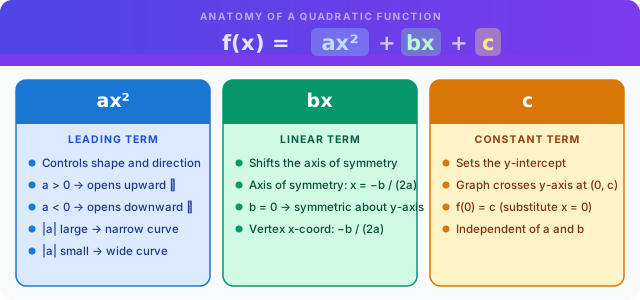
Before working with the formula, you need to understand what each of the three coefficients does to the shape of the parabola. Think of building a parabola in stages: the leading term $ax^2$ gives you the basic bowl shape; the middle term $bx$ slides it left or right; and the constant $c$ lifts or lowers it vertically.
The leading coefficient a
The coefficient $a$ in front of $x^2$ is the most important single number in the function. Its sign determines whether the parabola opens upward ($a > 0$, cup shape ∪) or downward ($a < 0$, cap shape ∩). Its magnitude $|a|$ controls how wide or narrow the cup is: a large $|a|$ produces a narrow, steep parabola; a small $|a|$ near zero produces a wide, shallow one.
When $a > 0$, as $|x|$ grows large the term $ax^2$ dominates and becomes a large positive number — so $f(x) \to +\infty$ on both sides. The function has a minimum point (the vertex) in the middle. When $a < 0$, the same reasoning shows $f(x) \to -\infty$ on both sides, so the function has a maximum point at the vertex. No other shape is possible.
The linear coefficient b
The coefficient $b$ does not change the shape of the cup — it shifts the entire parabola horizontally. Specifically, $b$ determines the axis of symmetry, the vertical line through the vertex:
When $b = 0$, the axis of symmetry is $x = 0$ (the y-axis), and the parabola is perfectly centred. Changing $b$ moves the axis left or right. Notice that $b$ always appears together with $a$ in the formula — the shift depends on both.
The constant term c
The constant $c$ is the simplest to read: it is the y-intercept. Substituting $x = 0$ into $f(x) = ax^2 + bx + c$ gives $f(0) = c$ directly. Whatever the values of $a$ and $b$, the graph always crosses the y-axis at the point $(0,\ c)$.
The Parabola and Its Key Features
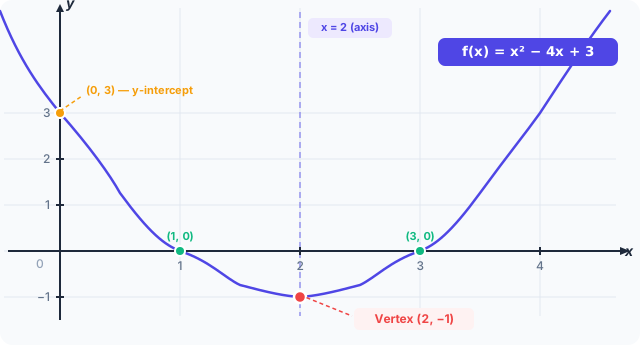
The graph of every quadratic function is a parabola. There are five features you should be able to identify and calculate for any parabola: the vertex, the axis of symmetry, the y-intercept, the x-intercepts (also called roots or zeros), and whether it opens upward or downward.
Finding the vertex
The vertex is the turning point of the parabola — the minimum if $a > 0$, the maximum if $a < 0$. Its x-coordinate is the axis of symmetry $x = -b/(2a)$. Once you have the x-coordinate, substitute it back into the function to find the y-coordinate:
For Figure 2, with $f(x) = x^2 - 4x + 3$, we have $a = 1$ and $b = -4$, giving $x = -(-4)/(2 \cdot 1) = 2$. Then $f(2) = 4 - 8 + 3 = -1$. Vertex: $(2,\,-1)$. ✓
Finding x-intercepts (roots)
The x-intercepts are the points where the parabola crosses the x-axis, i.e., where $f(x) = 0$. Solving $ax^2 + bx + c = 0$ is the central problem of quadratic algebra, and we will cover three methods in the sections that follow. For now, note that a parabola can cross the x-axis at two points, one point (touching the axis, called a repeated root), or zero points — and the discriminant (Section 5) tells you which case you are in without doing the full calculation.
The Quadratic Formula — Full Mathematical Depth
Intuition before symbols
Suppose you need to solve $ax^2 + bx + c = 0$ but you cannot see an obvious factoring. The key insight is that any quadratic can be rewritten in the form $a(x - h)^2 = k$ for some numbers $h$ and $k$. This process is called completing the square. Once you have that form, taking the square root of both sides isolates $x$. The quadratic formula is exactly what you get when you carry out completing the square on the completely general equation $ax^2 + bx + c = 0$ — with $a$, $b$, and $c$ kept as letters rather than specific numbers. You only have to do this algebra once, and the resulting formula works for every quadratic equation that will ever exist.
The formula
Symbol dictionary
| Symbol | Meaning |
|---|---|
| $x$ | The unknown — the value(s) of $x$ that make the equation equal zero |
| $a$ | The leading coefficient (the number in front of $x^2$); must be non-zero |
| $b$ | The linear coefficient (the number in front of $x$); can be any real number including zero |
| $c$ | The constant term (the number with no $x$); can be any real number including zero |
| $\pm$ | "Plus or minus" — generates two separate solutions: one using $+$ and one using $-$ |
| $\sqrt{\phantom{b^2}}$ | The principal (positive) square root |
| $b^2 - 4ac$ | The discriminant — the expression under the square root sign (covered in Section 5) |
| $2a$ | The denominator — the entire expression $-b \pm \sqrt{b^2-4ac}$ is divided by $2a$ as a whole |
Term-by-term breakdown
The numerator $-b \pm \sqrt{b^2 - 4ac}$: The $-b$ shifts the axis of symmetry — recall $x_{\text{axis}} = -b/(2a)$, so $-b/(2a)$ is the midpoint between the two roots. The $\pm\sqrt{b^2-4ac}$ term then adds and subtracts an equal distance on either side of that midpoint to reach each root. This is why both roots are always symmetric about the axis $x = -b/(2a)$.
The denominator $2a$: Dividing by $2a$ achieves two things. It scales the result correctly (larger $|a|$ means the parabola is narrower, so the roots are closer together), and it carries the sign of $a$ (ensuring that when $a < 0$ the roots are still calculated correctly).
Why $\pm$ gives two solutions: Taking the square root of a positive number always produces two values — one positive and one negative — because both $(\sqrt{k})^2 = k$ and $(-\sqrt{k})^2 = k$. The $\pm$ symbol captures both at once. When $b^2 - 4ac = 0$, the two values coincide at a single repeated root.
The Discriminant — Predicting Solutions Without Solving
The expression $\Delta = b^2 - 4ac$ (the Greek letter delta, $\Delta$, is the standard notation for the discriminant) appears under the square root in the quadratic formula. Before you do any computation, the sign of $\Delta$ tells you exactly how many real solutions the equation has:
| Discriminant $\Delta = b^2 - 4ac$ | Number of real solutions | Graph behaviour |
|---|---|---|
| $\Delta > 0$ | Two distinct real solutions | Parabola crosses x-axis at two different points |
| $\Delta = 0$ | One repeated real solution | Parabola touches x-axis at exactly one point (vertex on axis) |
| $\Delta < 0$ | No real solutions | Parabola does not intersect the x-axis at all |
When $\Delta < 0$, the equation has no real solutions — but it does have two complex solutions involving imaginary numbers. At the high school level you will typically state "no real solutions" and stop there. Do not write "impossible" or "undefined" — the equation is perfectly valid, just without real-number answers.
Choosing the Right Solving Method
The quadratic formula always works, but it is not always the fastest route. The diagram below gives you a decision process for choosing the most efficient method for a given equation.
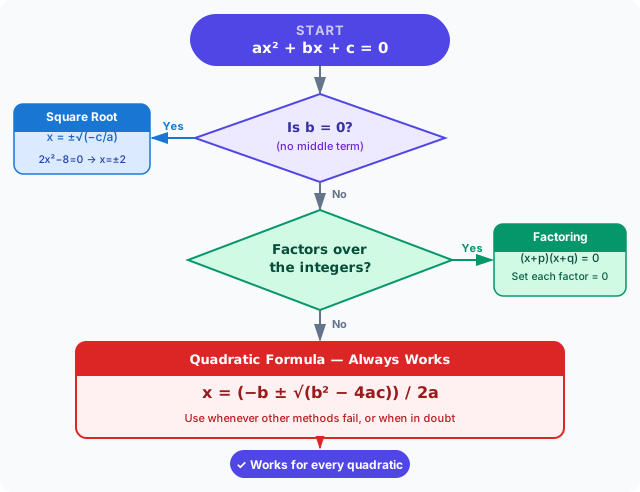
In summary: use the square root method when there is no $x$ term (e.g., $3x^2 - 27 = 0$); use factoring when you can spot integer pairs quickly (e.g., $x^2 - 5x + 6 = 0$); use the quadratic formula whenever the coefficients are messy fractions, decimals, or large numbers, or when you are not sure whether the equation factors at all.
Worked Example — Full Solution
Apply the quadratic formula step by step to the following equation. Every arithmetic operation is shown explicitly — nothing is skipped.
Identify the coefficients.
Read off $a$, $b$, $c$ directly from the equation $2x^2 + x - 3 = 0$:
Note that $b = 1$ (the coefficient of $x$ is $1$, not zero), and $c = -3$ (the constant is negative — it came from the "$-3$" term).
Calculate the discriminant.
Since $\Delta = 25 > 0$, we know before finishing that there will be exactly two distinct real solutions. The parabola crosses the x-axis at two points.
Take the square root of the discriminant.
We are fortunate: $25$ is a perfect square, so the answer is a whole number.
Substitute into the quadratic formula.
Evaluate the two solutions separately.
Using $+$:
Using $-$:
Verify both solutions by substituting back.
Check $x_1 = 1$:
Check $x_2 = -\tfrac{3}{2}$:
The equation $2x^2 + x - 3 = 0$ has two solutions: $x = 1$ and $x = -\tfrac{3}{2}$. Graphically, the parabola $f(x) = 2x^2 + x - 3$ crosses the x-axis at these two points. The vertex lies exactly halfway between them, at $x = \tfrac{1 + (-3/2)}{2} = -\tfrac{1}{4}$, consistent with the axis of symmetry formula $x = -b/(2a) = -1/(4) = -\tfrac{1}{4}$.
Practice Problems
Apply what you have learned. For each problem: identify $a$, $b$, $c$; compute the discriminant; then find the solution(s). Use the hint button if you get stuck.
Solve $x^2 - 7x + 10 = 0$ using the quadratic formula. Then verify by factoring.
For the equation $x^2 + 4x + 4 = 0$, compute the discriminant and describe what it tells you about the graph before finding the solution.
A ball is thrown upward and its height in metres after $t$ seconds is $h(t) = -5t^2 + 20t + 1$. At what time(s) does the ball return to a height of $1$ metre? What does the vertex represent physically?
This article covers the core of quadratic functions. The natural next steps are completing the square (which gives you vertex form $a(x-h)^2 + k$), quadratic inequalities, and systems involving quadratics. If you'd like a 1-on-1 session to work through any of these topics with a TutorDice tutor, your first session is free.